
If your home was built before 1965 anywhere in Southwestern Ontario, there is a good chance your exterior walls are completely empty. No batts, no board, nothing. That was the standard of the day. It is also the single biggest reason older homes feel drafty in January and stuffy in July, no matter how hard the furnace or the air conditioner works.
Drill and fill is the fix. It is a practical, non invasive way to insulate the exterior walls of an older home without tearing off siding or opening up the drywall inside. We use it every week on brick homes in Windsor, wood sided homes in Chatham, and cottages along the Lambton shore. This article walks through what it is, when it is worth doing, and what to expect if you decide to book it.
Why homes built before 1965 usually have no wall insulation
Before the energy shocks of the 1970s, insulating exterior walls was not standard practice in Ontario. Homes were built with heavier framing, wood or brick cladding, and plaster inside. Nobody was thinking about R value. Fuel was cheap and homes leaked warm air like a screen door.
The result is a housing stock full of solid, well built homes that are terribly inefficient. Pre-1965 homes in Windsor, Chatham, and Sarnia commonly test at R0 in the walls. For reference, current Ontario Building Code targets for new builds are north of R22 in above-grade walls. That is a big gap, and you feel it in every heating and cooling season.
What drill and fill actually is
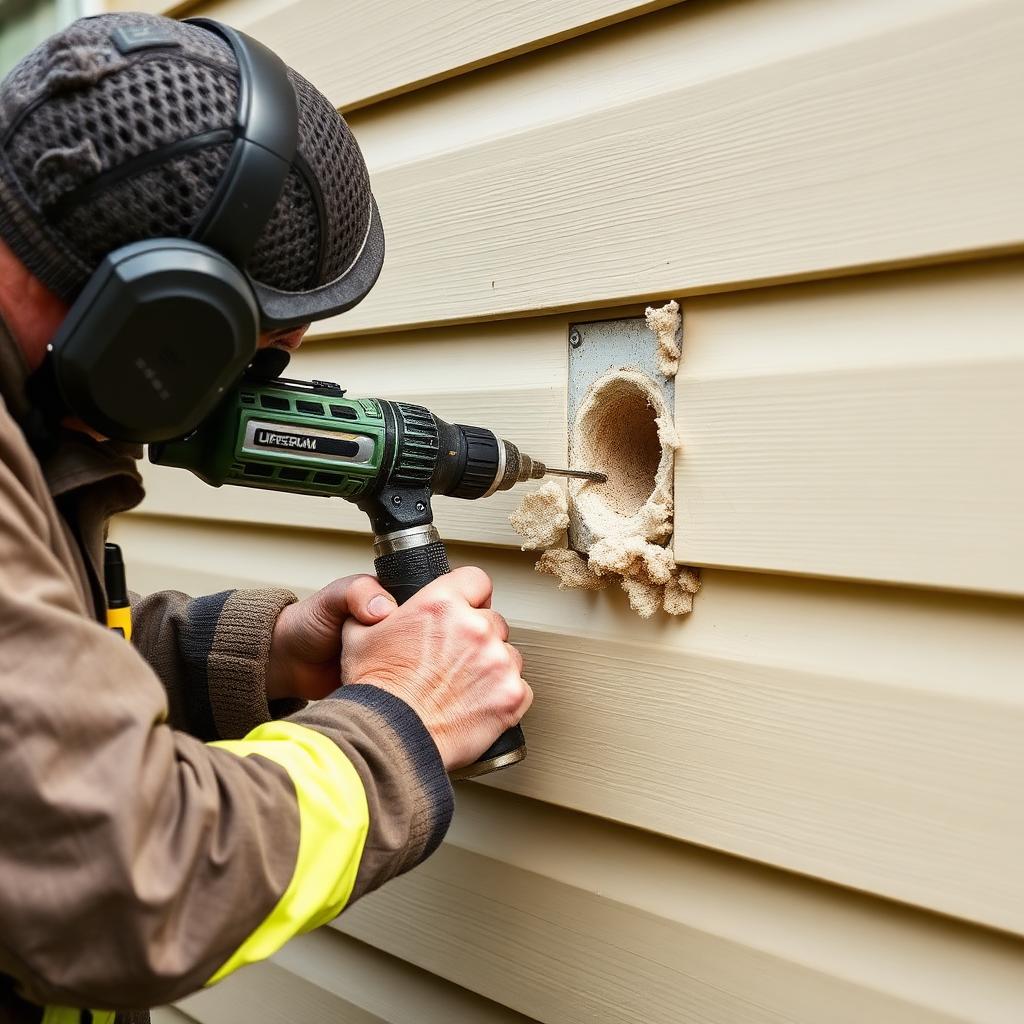
Drill and fill, sometimes called dense pack, is a retrofit technique that fills empty wall cavities with insulation through small access holes. We do not tear off the siding and we do not open up the interior. Depending on the home we access the wall either through the exterior cladding or through the interior finish, drill a small hole in each stud bay, feed a hose in, and pack the cavity with insulation until it stops taking material.
The most common material for drill and fill is dense pack cellulose. Cellulose is made from recycled paper treated with borate for fire and pest resistance. It is dense enough to resist settling, gentle enough not to damage plaster or brick, and effective at slowing air movement inside the wall.
How we access the wall
- From behind the siding. On homes with vinyl or aluminum siding, we can pull a single row, drill through the sheathing, fill each cavity, plug the hole, and put the siding back.
- Through mortar joints. On brick homes we drill through the mortar between the bricks, fill the cavity, and repoint the joint with a colour matched mortar.
- From inside the home. When the exterior is a historic finish or otherwise unrepairable, we drill from the interior side.
Why homeowners actually book it
- Cold exterior walls that they can feel with the back of a hand.
- Rooms that will not stay warm no matter what the thermostat says.
- A heating bill that keeps climbing year after year.
- Condensation on windows or upper corners of exterior walls.
- Traffic noise or wind noise on street-facing rooms.
- Getting the home ready for resale and wanting a strong energy story to tell.
What a typical project looks like
- Site visit and quote. We measure the exterior, look at the cladding and the interior finish, and confirm the wall assembly.
- Written quote. You get a written quote that spells out access strategy, material, expected coverage, and price.
- Prep. On install day we protect landscaping and any finishes near the work.
- Wall scan. We scan each wall to locate studs and identify any obstructions before we drill.
- Drill and pack. We drill an access hole in each stud bay and fill it with dense pack cellulose until it stops taking material.
- Patch and finish. Siding goes back, mortar joints get colour matched, and interior patches get sanded ready for paint.
- Photograph and record. We photograph the exterior and record material usage for rebate paperwork.
Costs, savings, and rebates in Ontario
A drill and fill on an average two storey home in Southwestern Ontario is usually in the $4,000 to $8,000 range, depending on the size of the home and access complexity. Most homeowners see a meaningful drop in their heating bill through the first Ontario winter after install. Wall insulation upgrades often qualify for federal and provincial rebates such as Enbridge Home Efficiency Rebate Plus. We prepare the paperwork so you actually collect the incentives you qualify for.
Is drill and fill right for your home?
If your home is older than 1965 in Southwestern Ontario, the answer is very often yes. The best way to know for sure is to have us come out. We will scan the walls, confirm what is or is not in there, and quote a specific plan for your home. No hard sell, no obligation.
Book a free quote or give us a call at (519) 796-3626.